
Courtney Adamsons' PhD Licentiate Seminar on Food Systems Governance
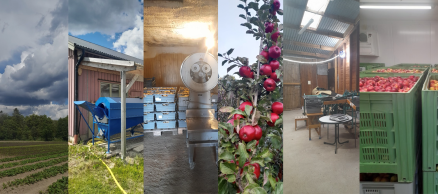
On Friday 6th of March, Courtney Adamson, a PhD student in the CO-SFSC project presented her research to date in a Licentiate seminar at KTH Royal Institute of Technology in Stockholm. Her research follows the work of practice partners in the Swedish hub in the project, with a specific focus on how food systems governance, and in particular local governance involving municipalities, can potentially enhance the sustainability and resilience of local and territorial food supply systems in the region of Sörmland in Sweden.
The abstract for the licentiate reads as follows:
In light of troubling trends, challenges and crises facing today’s food systems, the journey food makes from production to consumption must change significantly. One important lever for this is food-related governance, which is seen as an integral aspect requiring attention to facilitate food system change and potential transformations. In particular, research points to the need to govern food from an integrated systems perspective for long-term sustainability. While this point is increasingly clear on paper, how food system governance is achieved in practice is not. Further research is required to understand the challenges and opportunities for everyday food practitioners, such as farmers, wholesalers, cooks and dietary staff in public agencies, to work with food governance grounded in a systems perspective.
In light of this, this Licentiate thesis studies the practices of people working with food. The research focuses broadly on the efforts of public and private actors (such as municipalities and civil society organisations), and food practitioners, in relation to governance innovations concerning local produce and landscapes, with empirical cases in the region of Sörmland located southwest of Stockholm in Sweden. Transdisciplinary and ethnographic methods involving interviews and observations were employed to explore ongoing attempts at governing local food differently in practice. To avoid reproducing siloed perspectives anchored in either food production or consumption, this thesis employs a holistic social-ecological systems perspective, conceptualising local food as involving diverse forms of agency shaping food cultivation, production, processing, preparation and consumption, and emerging from the entangled relations of non-material and material elements and processes in practice. It does so by integrating research on food system governance with a practice perspective and resilience framing. Specifically, Paper I studies practice in municipal food supply systems in the region of Sörmland and provides insights into important non-material and material conditions, including governance conditions, to build up the so-called ‘missing middle’ of these systems. Paper II traces two ongoing local change processes in Sörmland and provides a performative account of enacting resilience capacities and governing for resilience, highlighting practitioners’ dynamic capacities to collectively work with change for implementing food system governance in practice. The thesis gives rise to three main contributions. Firstly, it provides practical insights into how challenges and opportunities for integrated food system governance play out in the interactions between diverse forms of agency in local food systems. Secondly, it provides an account of governance change from a practice theoretical perspective. Finally, the thesis illustrates how a focus on practice and capacities for resilience in change processes can help reveal the necessary conditions for implementing food system governance in practice.